

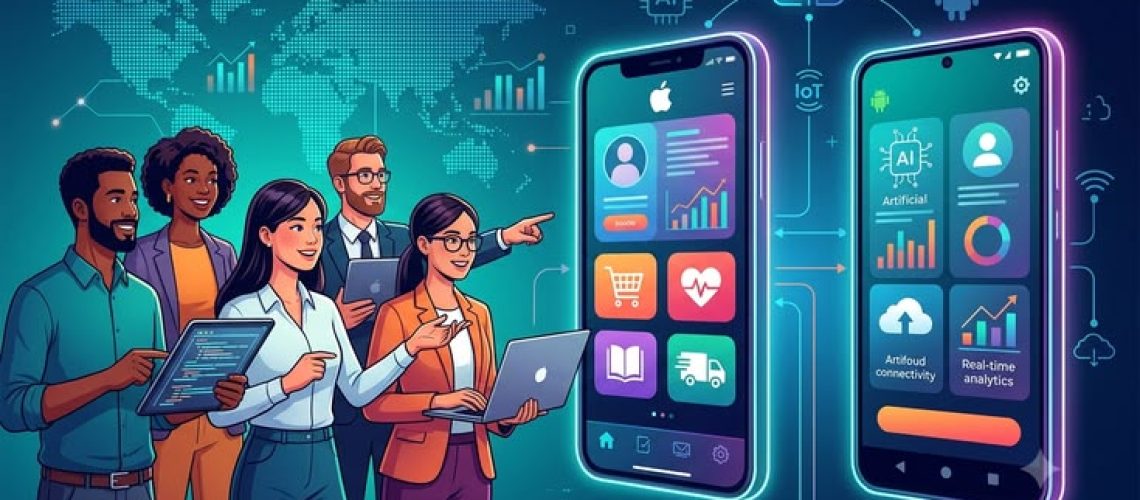
Mobile applications have changed the way people interact with businesses, digital services, and online platforms. Beyond providing convenient access to products and services, modern apps can create experiences that are tailored to individual users. How Mobile Apps Support Personalized Experiences has become an important consideration for businesses looking to improve engagement, satisfaction, and customer retention.
Personalization allows an application to deliver relevant content, recommendations, notifications, and features based on a user’s preferences and interactions. When implemented responsibly, it can make an app feel more useful and easier to navigate while helping businesses better understand customer needs.
Understanding Personalized Mobile Experiences
A personalized mobile experience means that an application adapts certain aspects of its content or functionality according to the individual user. Instead of showing exactly the same information to everyone, the app can use available data and user interactions to provide more relevant experiences.
For example, an online shopping app can display products based on previous searches, while a streaming platform can recommend movies or music according to viewing or listening patterns. A fitness application can adjust workout suggestions based on a user’s activity and goals.
This type of personalization can help users find relevant information faster and reduce the effort required to navigate an application.
Using User Preferences
One of the simplest ways mobile apps support personalization is by allowing users to set their preferences. During registration or within application settings, users may select interests, language preferences, notification choices, content categories, or other options.
The application can then use these preferences to customize the experience. For example, a news app can prioritize selected topics, while a shopping platform can highlight preferred product categories.
Giving users control over their preferences can also improve transparency because individuals can decide what type of content they want to see.
Personalized Recommendations
Recommendation systems are widely used in modern mobile applications. These systems can analyze user interactions and identify patterns that may indicate specific interests.
E-commerce apps can recommend products based on browsing and purchasing behavior. Entertainment applications can suggest movies, shows, podcasts, or music based on previous activity. Food delivery platforms can highlight restaurants or dishes that may match a user’s previous orders.
Relevant recommendations can make an application more convenient by helping users discover content or products without manually searching through large collections.
Artificial Intelligence and Personalization
Artificial intelligence is making mobile personalization more sophisticated. AI systems can process large amounts of information and identify patterns that may not be obvious through simple rules.
For example, an AI-powered application can analyze previous interactions to predict what type of content a user may find useful. AI can also support personalized search, conversational assistants, product recommendations, and automated customer support.
As AI capabilities improve, mobile applications can respond more dynamically to changing user preferences while delivering more relevant experiences.
Location-Based Personalization
Mobile devices can provide location information when users grant the necessary permissions. Applications can use this information to provide location-relevant services and content.
For example, a travel app can highlight nearby attractions, while a retail application can show stores in the user’s area. Food delivery apps can use location information to display available restaurants and estimated delivery options.
Location-based personalization should always be handled responsibly, with clear permission settings and appropriate privacy practices.
Personalized Notifications
Notifications can be more useful when they are relevant to individual users. Instead of sending the same message to everyone, applications can use user preferences and activity to determine which notifications may be useful.
An e-commerce app might notify a customer about a product they previously viewed, while a fitness app may send a reminder based on a user’s selected schedule.
However, excessive notifications can negatively affect the user experience. Businesses should focus on sending timely and meaningful messages rather than maximizing notification volume.
Personalized User Interfaces
Personalization can also extend to the design and functionality of an application. Users may be able to customize themes, layouts, dashboards, shortcuts, or content categories.
For example, a financial application could allow users to prioritize specific account information on their dashboard. A productivity app might allow users to customize task views according to their workflow.
A flexible interface can help users create an experience that matches their individual needs.
Personalization Through User Behavior
Mobile applications can learn from interactions such as searches, clicks, purchases, content views, and feature usage. These behavioral signals can help businesses understand what users find useful.
For example, if a user regularly interacts with a particular category, the application may prioritize similar content. If a user frequently uses a specific feature, that functionality could be made easier to access.
Behavior-based personalization should be combined with clear privacy practices so users understand how their information is being used.
The Importance of Privacy and Security
Personalized experiences depend on data, making privacy and security essential. Mobile applications may process personal information, location data, preferences, and behavioral activity.
Businesses should collect only the information necessary for their services and use appropriate security measures to protect it. Users should also have clear choices regarding permissions, data collection, and communication preferences.
Trust is an important part of personalization. If users feel that their information is being handled responsibly, they are more likely to engage with digital services.
Benefits for Businesses
Personalization can provide benefits for both customers and businesses. Relevant recommendations can improve engagement, while customized content can encourage users to spend more time within an application.
Businesses can also use personalization to understand customer behavior and improve their products and services. Better understanding of user preferences can support targeted marketing, improved customer service, and stronger long-term relationships.
The objective should be to create genuine value rather than simply collecting more data.
The Future of Personalized Mobile Experiences
The role of personalization in mobile applications is expected to continue growing as AI, analytics, cloud technology, and connected devices become more advanced. Future apps may become increasingly adaptive, providing experiences that change according to context, preferences, and user needs.
However, successful personalization will require a balance between convenience and privacy. Businesses that combine intelligent technology with transparent data practices can create mobile experiences that are useful, relevant, and trustworthy.
Ultimately, How Mobile Apps Support Personalized Experiences is about more than displaying customized content. It is about understanding user needs and using technology to make digital interactions simpler, more relevant, and more valuable.