

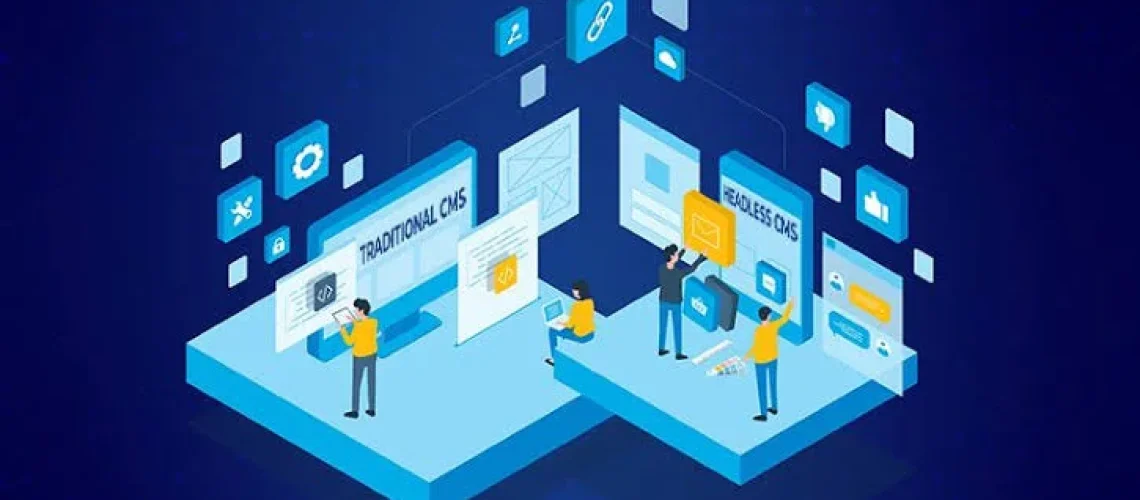
A Content Management System (CMS) plays an important role in creating, organizing, and publishing digital content. Traditional CMS platforms generally connect content management with the presentation layer of a website. A headless CMS takes a different approach by separating the content management system from the frontend presentation layer.
This architecture gives developers greater flexibility in how and where content is delivered. Content can be managed centrally and distributed to websites, mobile applications, digital platforms, and other connected experiences through APIs.
What Is a Headless CMS?
A headless CMS is a content management system that focuses primarily on creating, storing, organizing, and delivering content without controlling how that content is displayed on the frontend.
The backend manages content, while developers can build the frontend using technologies such as React, Vue, Angular, Next.js, or other frameworks. APIs connect the content repository with the chosen frontend.
This separation between the backend and frontend is the main characteristic of a headless CMS.
1. Greater Frontend Flexibility
One of the major benefits of using a headless CMS is frontend flexibility. Developers are not restricted to the templates or presentation system provided by a traditional CMS.
They can choose the technologies, frameworks, and design approaches that best suit the project. This makes it easier to create customized digital experiences while keeping content management separate.
2. Content Can Be Used Across Multiple Platforms
A headless CMS allows content to be delivered through APIs. This means the same content can potentially be used across websites, mobile applications, digital displays, portals, and other platforms.
For example, a business could create a product description once and distribute that content to its website and mobile application rather than maintaining completely separate content databases.
This centralized approach can make content management more efficient.
3. Better Scalability
As businesses grow, their digital requirements may become more complex. A headless architecture can support this growth by separating content management from frontend development.
Developers can modify or replace the frontend without necessarily rebuilding the underlying content system. New channels can also be connected to the existing content infrastructure when required.
This can be useful for organizations managing multiple digital products or expanding into new platforms.
4. Improved Website Performance
Headless CMS solutions can support modern frontend architectures that are designed for performance. Developers can use technologies such as static site generation, server-side rendering, caching, and content delivery networks depending on the project’s requirements.
A faster frontend can improve page responsiveness and create a smoother user experience.
However, a headless CMS does not automatically make a website faster. Performance depends on how the frontend, APIs, hosting infrastructure, media, and caching systems are implemented.
5. Freedom to Choose Development Technologies
Traditional CMS platforms can sometimes tie developers closely to a particular programming language, theme system, or plugin ecosystem.
A headless CMS provides greater freedom because the frontend can be developed independently. Teams can select technologies based on their technical skills and project requirements.
This is particularly useful for organizations that already have modern development teams and established frontend frameworks.
6. Easier Omnichannel Content Delivery
Businesses increasingly communicate with customers through multiple digital channels. A headless CMS can provide a central content repository that supports different frontend experiences.
The same structured content can potentially be delivered to:
- Websites
- Mobile applications
- Customer portals
- E-commerce interfaces
- Digital displays
- IoT devices
- Other API-connected applications
This makes headless architecture suitable for businesses with a broad digital presence.
7. Better Developer and Content Team Separation
A headless CMS can separate content responsibilities from frontend development.
Content teams can manage articles, images, product information, and other content through the CMS, while developers work independently on the presentation layer.
This separation can reduce dependencies between teams and allow content updates and software development to happen more independently.
8. Stronger Customization Options
Because the frontend is developed separately, businesses can create highly customized interfaces. Developers are not limited to the layouts offered by a particular CMS theme.
This can be valuable for organizations that require unique user experiences, advanced interactions, custom applications, or specialized digital platforms.
9. Improved Security Architecture
Separating the content management backend from the public-facing frontend can provide architectural security advantages. For example, organizations can limit direct exposure of the content management environment and use APIs to control how content is delivered.
However, security still depends on implementation. API authentication, authorization, access controls, infrastructure security, dependency management, and regular updates remain important.
10. Easier Technology Changes
Technology changes quickly, and businesses may eventually need to redesign or rebuild their frontend. With a headless CMS, the content repository can remain in place while the presentation layer is replaced.
For example, an organization could move from one frontend framework to another while continuing to use its existing structured content.
This can reduce the need to migrate content whenever the frontend technology changes.
11. Supports Modern Web Development
Headless CMS platforms work well with modern development approaches, including component-based architectures, API-driven applications, static site generation, server-side rendering, and other contemporary web technologies.
This makes them suitable for projects where developers require a high degree of control over the technical architecture.
12. Efficient Content Management
A structured content model can make it easier to organize and reuse information. Instead of creating content specifically for one webpage, businesses can structure content around reusable fields and components.
For example, a product could have separate fields for its name, description, specifications, images, features, and pricing. These fields can then be presented differently depending on the platform.
Is a Headless CMS Right for Every Business?
Despite the many benefits of using a headless CMS, it is not automatically the right choice for every website.
A traditional CMS may be more practical for a small business website that primarily needs simple pages, blogs, contact forms, and straightforward content management.
A headless CMS may be more suitable when an organization needs multiple digital channels, custom frontend experiences, advanced integrations, flexible technology choices, or large-scale content management.
It can also require more technical expertise because developers need to build and maintain the frontend separately from the CMS.
The benefits of using a headless CMS include greater frontend flexibility, multi-platform content delivery, scalability, customization, technology independence, and support for modern web development architectures.
By separating content management from presentation, a headless CMS gives businesses greater control over how their content is delivered across digital channels. However, the decision should be based on the website’s technical requirements, available development resources, content strategy, and long-term growth plans.


